
How Is AkiDevRule's Rule Corpus Loaded?
The rule corpus is AkiDevRule's whole rule library: 13 RULE-*.md files (behavior constraints) and 7 METHOD-*.md files (analysis frameworks). Loading everything would cost context in every session, so AkiDevRule uses two paths: a small part is always present, the rest is read at the right moment. For the product overview, see What Is AkiDevRule and the AkiDevRule project page.
Which Files Are Always Loaded Each Session?
Exactly two, @-imported in ~/.claude/CLAUDE.md: RULE-agent-behavior.md (how the agent communicates, when it must ask, how it reports) and the akirule router. Claude Code reads CLAUDE.md mechanically when a session opens, so these two are present without the model deciding to call anything. The cost is that they occupy context in every session, a deliberate price for a hard guarantee.
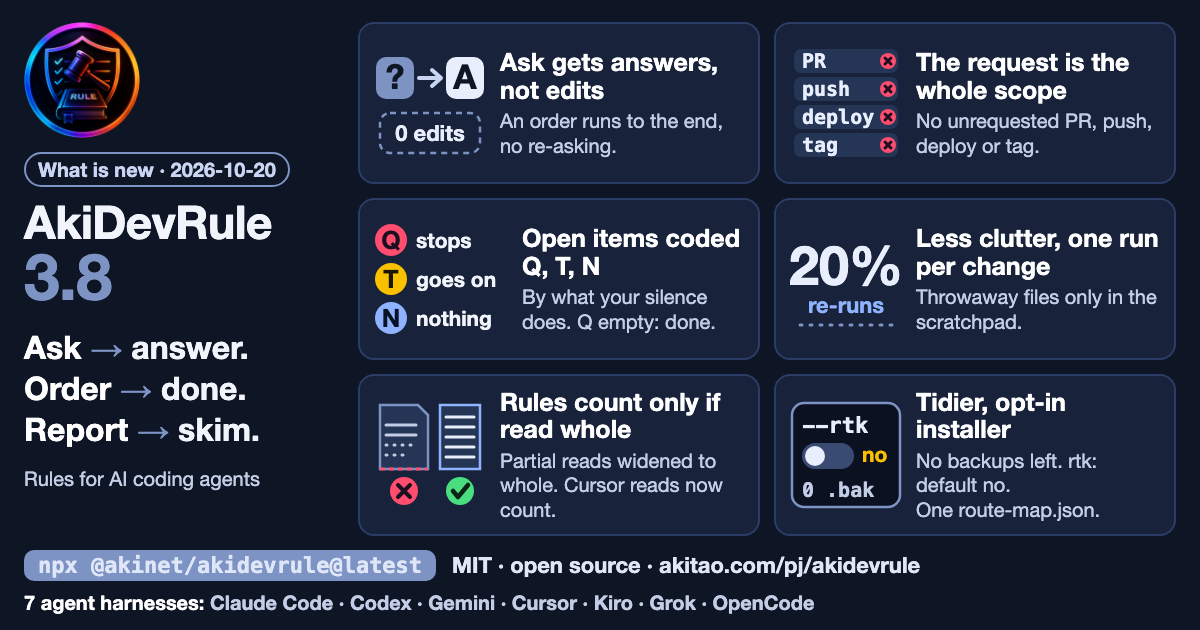
These two carry the rules you notice most in 3.8: a question gets only an answer, act only on an order, the request is the whole scope, and open items are coded Q, T, N. Details in Release 3.8.0.
How Does the akirule Router Pick Rules?
On each turn akirule asks two things: which domain the work touches (code, docs, UI, SEO, release, database...) and what the act is (create, decide, audit, ship). The agent then reads the matching files, in any language, so a different phrasing still hits. The routing table is deliberately sensitive: over-loading costs a few tokens, missing a rule costs wrong work. A turn that only looks something up or explains it loads no rule. To load everything, ask for the whole corpus.
How Do You Know the Agent Read a Rule Before Editing?
Reading a rule file is still the model's own step, so on Claude Code there is a gate: the aki-route-guard hook denies the first edit of each file type (code, .md, .vue, .sql...) until the matching rules were read whole in the session. Version 3.8 closes two gaps:
- A partial read (just the first lines) no longer counts as read; for a rule file, Claude Code now widens it into a whole-file read automatically.
- The "which path needs which rule" table lives in one data file,
route-map.json, instead of three hand-kept copies; the gate also reads Cursor transcripts now.
Why: in the author's own data, 7.7% of subagent rule reads were partial (the figure is in the 3.8.0 CHANGELOG), yet the report still claimed the file was read.
What Does a topic.A1 Rule Address Mean?
Each rule file is split into groups A, B, C with numbered items, for example agent.A3 (a question is not an order) or coding.B3 (what counts as verified). topic is the filename without its RULE- or METHOD- prefix. That lets you cite one exact rule in a prompt or commit without pasting its text.
What Are AkiDevRule's 11 Skills?
A skill is one command for one job, written on the open SKILL.md standard, so it syncs to Antigravity, Codex, Cursor, Kiro and Grok, not only Claude Code. The set: akirule, akiflow (an agent council run by a lead), akithink (deep thinking before a big decision), akihtmlreport, akihelp, akigitcommit (clean commits), akilint, akiopen (what is still unfinished when you open a project), akiship (the full release ritual), aki-article-writer and akidevsync-notes.
How Do the 5 Agent Definitions Differ From Skills?
The five agents (aki-hands, aki-judge, aki-conduct, aki-challenger, aki-maker) use Claude Code's own ~/.claude/agents/ format, so write access is limited by mechanism: a read-only agent's tools: field simply omits Edit and Write. Only aki-maker may write files. Because that format has one consuming tool today, the five agents install for Claude Code only, while skills install for several tools. Install steps are in Installing AkiDevRule for Claude Code; source on GitHub, package on npm.