What Is AkiDevRule?
AkiDevRule is a set of rules plus shared skills that keeps AI coding agents such as Claude Code on the task you gave them and their reports short. One install command puts it on your machine for 7 tools: Claude Code, Codex, Gemini/Antigravity, Cursor, Kiro, Grok and OpenCode. It is open source under the MIT license, maintained by Lạc Việt Anh on GitHub.
It is a command-line tool, not a web app: no interface, no account, no data collection. The project overview lives on the AkiDevRule project page.
How Does AkiDevRule Help a New Claude Code User?
AkiDevRule gives a newcomer a ready-made set of working rules instead of writing a CLAUDE.md from scratch. By default an agent tends to overreach: it edits what you only asked about, adds steps you did not request, and reports at length. The rules tell it up front to avoid that, and they are split into small files so the agent reads only what it needs, with no copying per tool.
Why Does AkiDevRule Exist?
Using several AI agents at once duplicates rules: one copy per tool, edit one and forget the others. AkiDevRule writes each rule once in one Git repository, and the installer produces the right shape for each tool. The repository is the single source; what is on your machine is a copy.
What Changed in Version 3.8?
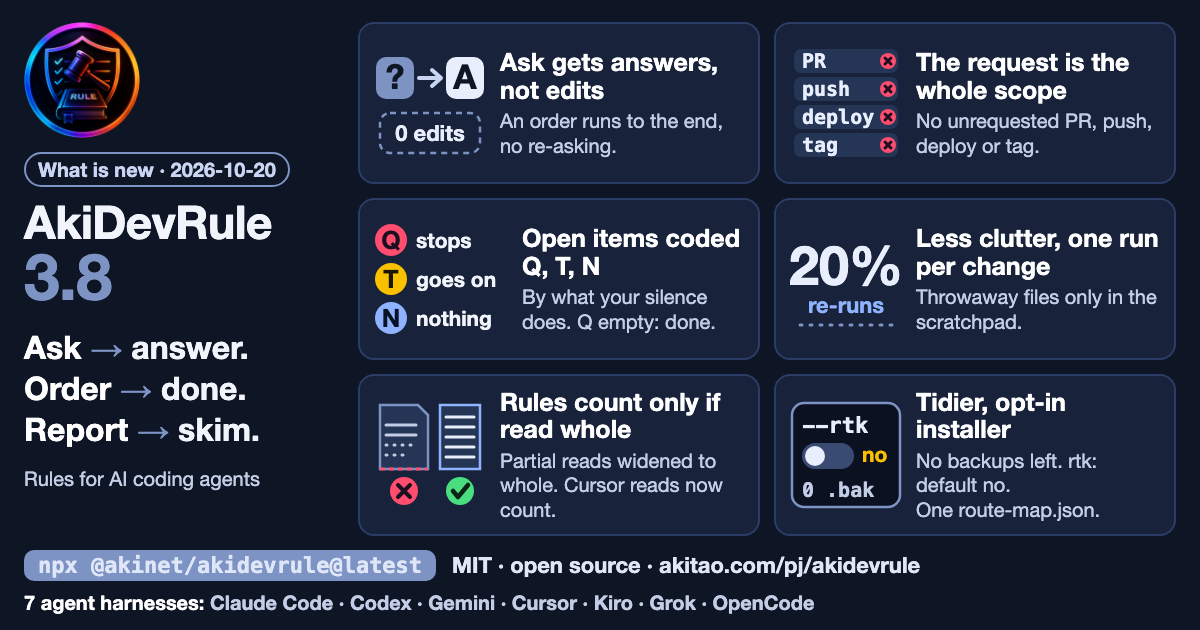
Version 3.8.0 (2026-10-20) fixes three habits that annoy people most, per Release 3.8.0:
- A question gets an answer, an order gets done. A question, a hedge or a remark about work nobody ordered gets an answer and no changed file. To make the agent act, use an action verb ("fix X"). Once you order, the agent runs to the end without asking again, and before its first write it must name the words of yours that ordered it.
- The request is the whole scope. The agent does not open a pull request, push, deploy or tag just because that is the usual next step; it finishes what was asked, then stops and reports.
- Open items are coded Q, T, N. Q is something you must answer before work continues. T is a call the agent took within your order, and your silence lets it proceed. N is a note, and your silence changes nothing. When no Q is left, you are done reading.
Version 3.8 also cuts clutter (throwaway files go to the scratchpad or are not made), runs each check once per change, counts a rule as read only when read whole, and stops the installer from leaving spare backup files.
What Does AkiDevRule Install?
- 13 RULE files and 7 METHOD files: RULE files constrain behavior (agent conduct, code, structure, docs, content, SEO, release, tests, DB...), METHOD files are analysis frameworks (deep thinking, flow audit, UX psychology...). Only the core behavior file and the router load every session; the rest load when your work touches their domain.
- 11 skills on the open
SKILL.mdstandard:akirule,akiflow,akithink,akihtmlreport,akihelp,akigitcommit,akilint,akiopen,akiship,aki-article-writer,akidevsync-notes. Each is one command for one job, for example/akigitcommitturns a messy tree into clean commits. - 5 pre-built agent definitions (Claude Code only): one that only finds facts, one that judges against exactly one standard, one that checks whether a rule was followed, one that challenges a result, and
aki-maker, the only agent allowed to write files.
Does AkiDevRule Update Itself?
No. It runs no background process and downloads nothing on its own. To move to a newer version you re-run the same install command; add --check to only compare the installed version with the latest without changing anything.
How Do You Install AkiDevRule?
npx @akinet/akidevrule@latestIt needs Node.js 18 or newer, nothing else, and no sudo. Step-by-step instructions for macOS, Linux and Windows are in Installing AkiDevRule for Claude Code; how rules load is in How AkiDevRule's rule corpus and skills load. Source and CHANGELOG are on GitHub, the package on npm.